
You are comparing Koala AI and Autoblogging.ai because Frizerly no longer fits how you publish. The wrong pick costs you hours per week in manual edits, or forces you to rewrite drafts that miss your SERP intent.
By the end, you will know how both tools handle bulk generation, semantic SEO, and publishing integrations, what each costs, and which one suits bloggers, agencies, or lean solo sites. The verdict is specific, not "it depends."
Quick Verdict: Koala AI vs Autoblogging.ai for Frizerly Users
If you're a Frizerly user seeking a new AI content platform, the quick verdict is that Autoblogging.ai excels for high-volume SEO automation with its 10+ modes and 500-article bulk generation, while Koala AI is better suited for simpler, budget-friendly content creation.
That single sentence captures the core trade-off. One platform is built for scale and search visibility. The other leans toward ease of use for writers who publish occasionally.
For anyone running a content-heavy site, the decision usually comes down to output capacity and SEO depth. Autoblogging.ai is trusted by 40,000+ content creators and has generated 1M+ articles, which speaks to how it performs under real publishing pressure.
| Factor | Autoblogging.ai | Koala AI |
|---|---|---|
| Best for | High-volume SEO automation | Simple, budget-friendly writing |
| Bulk generation | Up to 500 articles at once | Generally lighter batch options |
| AI modes | 10+ modes | Fewer, more basic modes |
| SEO tooling | SERP competitor analysis, semantic SEO tools, 21-point SEO audit | Limited SEO-specific features |
| WordPress publishing | One-click publish | Typically manual or plugin-based |
| Languages | 35+ languages | Narrower language coverage |
The table above reflects publicly available information about each platform's positioning. Where Koala AI's specifics are unclear, the comparison stays general on purpose.
Frizerly users often arrive with an existing library of posts and a workflow they don't want to rebuild. That makes workflow integration a deciding factor. Autoblogging.ai supports 35+ integrations and one-click WordPress publishing, which keeps blog post automation close to the tools most publishers already use.
Koala AI's appeal is straightforward. It tends to suit solo bloggers who want a clean interface and don't need heavy batch output. If your publishing cadence is a few posts a month, that simplicity can be enough.
The gap widens once you factor in quality controls. Autoblogging.ai includes a human proofreader in all plans, plus featured snippet optimization and semantic SEO tools. Those features matter when content quality and readability score directly affect rankings.
Budget-conscious users may find Koala AI attractive on cost alone. But cost per article changes quickly when you need bulk content creation, multilingual support, or keyword optimization at scale. Autoblogging.ai's 35+ languages and credit rollover help absorb that pressure over time.
Here is the short version for Frizerly users weighing the switch:
- Choose Autoblogging.ai if you publish often, care about SERP analysis, and want SEO content automation in one place.
- Choose Koala AI if your needs are modest and you prefer a lighter, simpler tool.
- Consider your WordPress publishing and API connectivity needs before deciding.
Neither platform is a poor choice. The right fit depends on whether you're optimizing for volume and search performance or for simplicity and lower upfront cost. For most Frizerly users scaling a content operation, Autoblogging.ai's 10+ modes and 500-article bulk generation make it the stronger fit.
At a glance: how Autoblogging.ai compares to Koala AI on the features that matter most.
| Feature | Autoblogging.ai | Koala AI |
|---|---|---|
| Pricing | $19-$999/mo | $25-$2,000/mo |
| Free plan / trial | Free credits | Free start, no card |
| WordPress integration | ✓ | ✓ |
| Bulk content generation | ✓ | ✓ |
| SEO optimization tools | ✓ | ✓ |
| API access | — | ✓ |
| AI image generation | ✓ | ✓ |
| Human proofreader | ✓ | — |
What Is Autoblogging.ai?
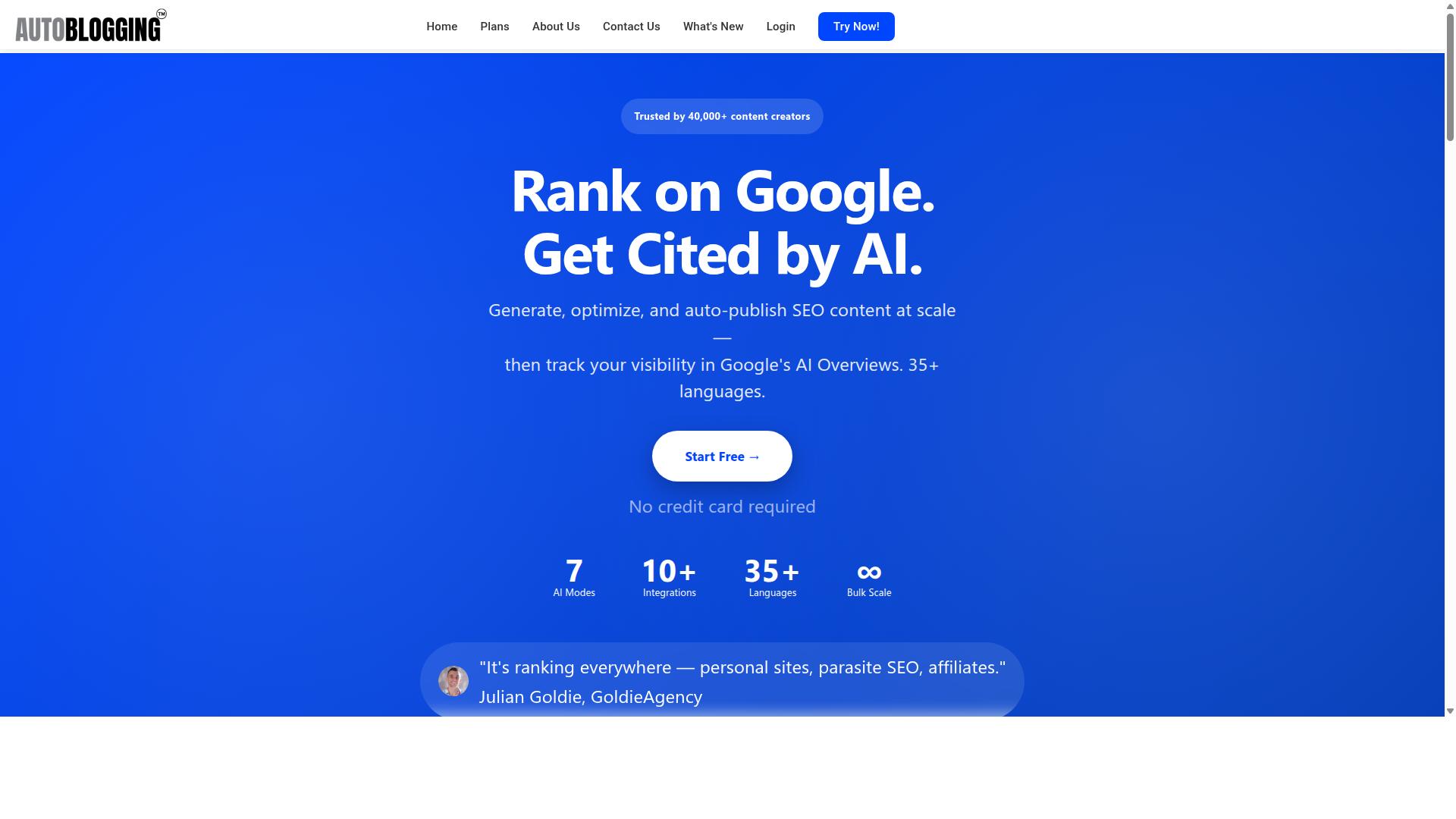
Autoblogging.ai is a SaaS platform developed by Digimetriq.com that automates the creation of SEO-optimized articles using advanced AI modes, designed to save time for bloggers, agencies, and affiliate marketers.
The product launched in 2022, founded by Vaibhav Sharda, and it has grown into a globally available tool for automated content generation. Its stated mission is straightforward: help bloggers, website owners, and agencies save time and improve their online presence through cutting-edge technology.
That mission shapes how the platform positions itself against general-purpose AI writing tools. Rather than treating article creation as a one-off task, Autoblogging.ai frames it as a repeatable production process, one where a first draft can be generated at scale instead of written from a blank page.
Two goals sit at the center of the brand's philosophy. First, cut down content costs. Second, enable human counterparts within existing standard operating procedures by supplying that first draft. Digimetriq, the parent company, states an even longer-term aim: replacing human counterparts entirely.
The target audience reflects this production-focused approach:
- Bloggers who need a steady stream of posts without writing each one manually
- Website owners managing content for their own properties
- Agencies producing articles on behalf of multiple clients
- Affiliate marketers building out review and informational content at volume
Key capabilities include AI article generation and bulk output, both of which matter when a workflow depends on publishing consistently rather than occasionally. The specifics of how those capabilities work are covered later in this comparison.
Global availability matters here too. Because Autoblogging.ai serves users across different regions and content markets, it fits into workflows that general-purpose tools may not address as directly, particularly when the goal is SEO content automation rather than casual drafting. For readers weighing Koala AI, Frizerly, or other AI writing tools, understanding what Autoblogging.ai actually is provides the baseline for every comparison that follows.
What Is Koala AI?
Koala AI is a web-based AI writing assistant that helps users generate blog posts, articles, and marketing copy using large language models, with a focus on simplicity and affordability.
The tool belongs to a broad category of AI writing tools that emerged as GPT-4 and similar large language models became widely accessible. Most of these platforms wrap a chat-style interface around a text generation engine, then add templates for common formats like outlines, product descriptions, and social captions.
Koala AI generally follows that pattern. Users type a prompt or a working title, choose a tone or length, and receive a draft they can edit inside the tool. The emphasis tends to be on ease of use rather than on deep publishing infrastructure.
That makes it a reasonable entry point for someone who needs basic AI writing help without advanced automation. A solo blogger drafting one post at a time, for instance, may find that a simple generator covers most of what they need.
Where tools in this class often differ is in what happens after the draft exists. Common capabilities to check include:
- Whether the tool can publish directly to a CMS such as WordPress or requires a manual copy and paste step
- Whether it connects to automation platforms like Zapier or Make, or exposes an API for custom workflows
- Whether it supports content scheduling, bulk content creation, or one-off generation only
- Whether keyword optimization or SERP analysis is built in or handled elsewhere
None of those items should be assumed for Koala AI without checking its current documentation, since feature sets in this market change frequently. What can be said generally is that simpler writing assistants tend to stop at the draft stage.
For readers comparing Frizerly alternatives, the practical question is not whether a tool can write. Most can. The question is how much of the surrounding workflow, from keyword research through publishing, the tool handles on its own.
Koala AI appears positioned closer to the drafting end of that spectrum. It suits writers who want a straightforward AI article writer and are comfortable managing scheduling, publishing, and SEO content automation through other means.
Readers who expect blog post automation to run with minimal manual steps should look closely at how each option handles workflow integration before committing. A tool that writes well but requires constant hand-holding may cost more time than it saves once volume increases.
In short, Koala AI is best understood as a general-purpose AI writing assistant rather than a full content marketing software suite. That is not a flaw, but it does shape which users get the most from it.
Features Compared
When comparing features, Autoblogging.ai and Koala AI cater to different needs: Autoblogging.ai offers advanced SEO automation and bulk generation, while Koala AI focuses on straightforward content creation. That difference shapes everything from how many articles you can produce in a session to how deeply each piece is optimized before it goes live.
Autoblogging.ai is built for high-volume SEO content, with more than 10 AI modes covering everything from quick drafts to competitor-driven deep analysis. Koala AI takes a simpler path, generally centered on producing one article at a time with basic customization options.
The sections below break the comparison into three practical areas: generation modes and bulk output, SEO and optimization tools, and integrations with publishing workflows. Readers juggling multiple client sites or affiliate projects will find the bulk and automation differences matter most, while solo bloggers may weigh simplicity against depth.
Neither tool is "better" in the abstract. The right pick depends on whether your workflow needs scale and SEO automation or a lean, low-friction writing assistant.
Content Generation Modes and Bulk Output
Autoblogging.ai provides multiple content generation modes including Quick Mode for free single articles and Godlike Mode for in-depth SERP analysis, and it can produce up to 500 articles in bulk, whereas Koala AI typically generates one article at a time with basic customization.
The mode lineup is the clearest dividing line. Autoblogging.ai's Quick Mode covers free single articles plus a wizard option, making it easy to test output quality before committing. Godlike Mode goes further, pulling in SERP competitor analysis, LSI keywords, and knowledge graph extraction to shape each draft.
Beyond those two, the platform adds News Mode with Google News integration and an Amazon Reviews Mode, giving content marketers formats for timely and product-focused pieces without switching tools.
Bulk output is where the gap widens most:
- Autoblogging.ai: up to 500 articles generated in bulk via CSV upload, suited to large sites, niche portfolios, and agency clients
- Koala AI: generally oriented around single-article generation, with bulk options that appear limited based on publicly available information
For anyone managing dozens of pages at once, bulk content creation via CSV turns a week of manual writing into a single upload. Koala AI's simpler approach may suit writers who prefer crafting each post individually, but it likely means more hands-on time per article.
SERP Analysis, Semantic SEO, and Optimization Tools
Autoblogging.ai's Godlike Mode performs SERP competitor analysis, extracts LSI keywords and knowledge graphs, and optimizes for semantic SEO, while Koala AI offers basic keyword suggestions and readability checks without deep SERP integration.
This is the area where SEO content automation separates the two platforms most sharply. Autoblogging.ai's optimization layer includes a 21-point semantic SEO audit, a Snippet Optimizer for featured snippet targeting, Topical Maps, Fan Out Queries, and an Intense Optimizer. Together, these tools aim at the signals search engines actually reward: topical coverage, entity relationships, and query intent.
The platform also ships an AI Proofreader and a Human Proofreader, the latter included in all plans, which addresses two common concerns with AI writing tools: content quality and the polish needed before publishing.
Koala AI, by general account, provides standard SEO assistance such as keyword optimization and readability scores. Those are useful for basic on-page checks, but they lack the depth of SERP-driven automation.
In practice, the difference shows up in how much manual research you do. With Autoblogging.ai, keyword optimization and competitor analysis feed directly into generation rather than sitting in a separate step. With Koala AI, expect to handle more of that groundwork yourself.
Integrations, Languages, and Publishing Workflow
Autoblogging.ai supports 35+ integrations including WordPress, Zapier, and n8n, offers 35+ languages, and enables automated publishing and scheduling, whereas Koala AI provides basic WordPress export and fewer language options.
Publishing is where workflow integration decides how much time you actually save. Autoblogging.ai connects to WordPress with unlimited sites, one-click publishing, a plugin, and scheduled auto-posting. It also reaches Web 2.0 platforms like Medium, Dev.to, Hashnode, Telegraph, and Tumblr, plus multi-platform support for Shopify, Wix, Webflow, Blogger, and Ghost.
For teams running content scheduling across several properties, the API, Zapier, and n8n connections allow automated content generation to slot into existing pipelines. A Content Repurposer rounds out the workflow by extending the life of published pieces.
Language coverage reaches 35+ languages, which supports multilingual support and language localization for audiences beyond English.
Koala AI, based on publicly available details, likely integrates with WordPress and offers some language options, though not as many, and it appears to lack the advanced automation layer. The table below summarizes the contrast:
| Capability | Autoblogging.ai | Koala AI |
|---|---|---|
| WordPress publishing | Unlimited sites, one-click, plugin, scheduled auto-posting | Basic WordPress export, likely |
| Automation tools | API, Zapier, n8n | Limited or unclear |
| Languages | 35+ | Fewer options |
| Extra platforms | Medium, Dev.to, Shopify, Wix, and more | Not widely documented |
For readers weighing a Frizerly alternative, the deciding factor is often whether blog post automation needs to run on autopilot. Autoblogging.ai is designed for that end-to-end flow, from generation through scheduled publishing.
Pricing Compared
Autoblogging.ai offers monthly plans starting at $19 for 40 credits up to $999 for 5,000 credits, with annual discounts and credit rollover, while Koala AI's pricing is generally lower but may lack rollover and advanced features.
The table below shows how the two tools line up on cost structure. Autoblogging.ai's figures come from its published plans, while Koala AI's side stays general because its pricing can shift with plan changes and usage limits.
| Factor | Autoblogging.ai | Koala AI |
|---|---|---|
| Entry price | $19/month for 40 credits | Generally lower for basic use |
| Top monthly tier | $999/month for 5,000 credits | Varies by plan |
| Annual billing | Discounted yearly rates on every tier | Availability varies |
| Credit rollover | Included on all plans | May not be offered |
| Free entry | 10 free credits per month, no card required | Varies by plan |
Autoblogging.ai spreads its tiers across six monthly options. Starter costs $19 for 40 credits, Regular costs $49 for 120, Standard costs $99 for 300, Gold costs $179 for 600, Premium costs $249 for 1,000, and Enterprise costs $999 for 5,000.
Annual billing lowers every tier. Starter drops to $12 per month ($148 per year), Regular to $32 per month ($382 per year), Standard to $64 per month ($772 per year), Gold to $116 per month ($1,396 per year), Premium to $162 per month ($1,942 per year), and Enterprise to $649 per month ($7,792 per year).
Two details stand out for anyone weighing automated content generation at scale. First, credits roll over on all plans, so unused capacity is not lost at the end of a billing cycle. Second, new accounts receive 10 free credits per month with no credit card required, which lets you test the workflow before committing.
Koala AI's pricing is generally lower for light, occasional use, and that can suit a solo blogger publishing a handful of posts each month. The trade-off is that lower-tier plans may not include rollover, and they may not reach the volume that heavier bulk content creation demands.
Autoblogging.ai also sells additional credits on top of any plan, and offers Done For You packages: Starter at $1,200 for 1,000 articles, Pro at $1,600, Corp at $4,000, and Senpai at $10,000, each covering 1,000 articles. Payment options include Visa, MasterCard, American Express, PayPal, and bank transfers for annual enterprise plans through Stripe, and you can cancel anytime.
For a reader comparing Frizerly alternatives, the practical question is not which tool is cheapest at the entry point. It is whether the plan you buy still fits when SEO content automation becomes a weekly habit rather than a one-off experiment. Rollover and a clear path from 40 to 5,000 credits give Autoblogging.ai more room to grow with your publishing schedule.
Who Should Choose Autoblogging.ai
Autoblogging.ai is ideal for Frizerly users who need to scale content production, such as SEO agencies, affiliate marketers, and bloggers managing multiple sites, thanks to its bulk generation, advanced SEO modes, and extensive integrations. Where Koala AI tends to suit writers who want a friendly single-article editor, Autoblogging.ai is built for people whose real problem is volume.
That distinction matters when content is a business asset rather than a one-off task. If you publish a handful of posts a month, almost any AI article writer will do. If you publish across several properties at once, the deciding factor becomes how much of the process runs without you.
The platform's target audience reflects that reality. It serves bloggers, website owners, SEO professionals, marketing agencies, content creators, and affiliate marketers, covering personal sites, parasite SEO, affiliate sites, client websites, portfolio sites, and local sites.
In practice, that means a few recognizable scenarios where Autoblogging.ai fits best:
- Agencies producing content for multiple client websites, where consistent output across accounts matters more than polishing a single post.
- Affiliate marketers running portfolios of niche sites that need steady publishing to stay competitive.
- Parasite SEO practitioners who need large amounts of content placed on third-party platforms.
- Local site owners covering many service areas or locations, where each page follows a similar structure.
- Bloggers scaling from one site to several and no longer able to write everything personally.
The common thread is time. Automated content generation removes the repetitive parts of publishing, from drafting to pushing posts live, so effort shifts toward strategy, keyword optimization, and human editing where it actually changes outcomes.
Adoption is another signal worth weighing. Autoblogging.ai reports a user base of 40,000+ users and a 4.9 rating, which suggests the workflow holds up for people publishing at scale rather than just at demo level. A large user base does not guarantee fit, but it does mean the tool has been stress-tested by many of the exact profiles listed above.
Frizerly users weighing the switch should ask one question: is your bottleneck writing quality or publishing throughput? If it is throughput, Autoblogging.ai is the more natural home. If you only ever publish occasionally and enjoy hands-on drafting, a lighter tool may be enough.
Who Should Choose Koala AI
Koala AI is a better fit for individuals or small businesses with limited budgets who need occasional blog posts or marketing copy and prefer a simple, no-frills AI writing tool. If your publishing calendar tops out at a handful of articles per month, a lightweight option can cover that ground without adding overhead.
The typical Koala AI user tends to be a solopreneur, hobby blogger, or a small team testing the waters of AI writing tools for the first time. They usually want a clean interface, a short learning curve, and output they can lightly edit and publish. Advanced SEO content automation, bulk content creation, and deep workflow integration are not the priority.
That profile makes sense when the goal is speed over scale. A single author writing one or two posts a week rarely needs API connectivity, Zapier integration, or Make automation. A manual, browser-based writing tool fits that rhythm just fine.
Koala AI also appeals to writers who prefer a hands-on drafting process. Instead of queueing up automated content generation across an entire site, they open the tool, write a prompt, review the draft, and refine it themselves. For people who enjoy that level of control, a simpler tool is often the more comfortable choice.
Where this approach starts to strain is volume. Once a blog grows past a few posts a month, or once keyword optimization, content scheduling, and WordPress publishing enter the picture, manual workflows become a bottleneck. At that point, the trade-off shifts from simplicity to time cost.
In short, Koala AI suits low-volume, budget-conscious writers who value ease of use over scale. Readers planning to grow a content operation, or who need consistent output tied to SEO content automation, should weigh whether a manual tool will still fit six months from now.
Final Verdict
For Frizerly users prioritizing scale, SEO automation, and integrations, Autoblogging.ai is the clear winner with its 10+ AI modes, 35+ languages, and 40,000+ trusted users, while Koala AI remains a solid choice for simple, budget-conscious content creation.
The core difference comes down to ambition level. If your goal is publishing a handful of posts each month to support a small site, a lighter tool can get the job done. If your goal is growing an audience, capturing search traffic, and doing it across multiple markets, you need a platform built for volume and search visibility from day one.
Autoblogging.ai has generated 1M+ articles and holds a 4.9 rating, with weekly updates keeping the platform current. That track record matters when you are committing a real content calendar to a single tool.
Koala AI, by contrast, appeals to users who want something straightforward and low-cost. It is a reasonable entry point, but it is not positioned as a high-volume SEO content automation engine the way Autoblogging.ai is.
Here is how the two stack up on the factors that matter most for a Frizerly alternative:
| Factor | Autoblogging.ai | Koala AI |
|---|---|---|
| AI modes | 10+ | Generally basic generation options |
| Languages | 35+ | Limited multilingual support |
| User base | 40,000+ trusted users | Smaller, less established base |
| Articles generated | 1M+ | Not publicly documented at this scale |
| Rating | 4.9 | Mixed or limited public ratings |
| Updates | Weekly | Less frequent release cadence |
| Best for | High-volume, SEO-driven publishing | Simple, budget-conscious content |
The pattern is consistent. Autoblogging.ai is built for bulk content creation, keyword optimization, and workflow integration, while Koala AI serves a narrower, simpler use case. Neither is wrong, but only one is designed to scale with a serious content operation.
If you are weighing content marketing software for the long term, the deciding question is simple: do you want a tool that grows with your publishing goals, or one you will likely outgrow within a few months?
To explore the platform for yourself, you can reach the Autoblogging.ai team through the channels below. They are available 7:00 to 19:00 IST for questions about features, workflow integration, and fit for your specific setup.
- India office: 501, Trinity Orion, Vesu, Surat 395007, Gujarat, India
- Phone / WhatsApp: +91 84605-06553
- Email: [email protected]
- Skype: vibes.yb
- United Kingdom office: 2nd Flr, SEO Content Suite, 35 Water Ln, Wilmslow, Cheshire SK9 5AR
- UK phone: +44 1625 359056
- Social: Facebook, Twitter, LinkedIn
Try Autoblogging.ai and see how its 10+ AI modes, 35+ languages, and weekly updates fit your content workflow. With 40,000+ users and 1M+ articles already generated, it is the stronger Frizerly alternative for teams that treat content as a growth channel rather than an afterthought.
Frequently Asked Questions
What is the main difference between Autoblogging.ai and Koala AI?
Autoblogging.ai is an AI article generation platform built by Digimetriq.com, offering 10+ AI modes including Quick Mode, Godlike Mode (with SERP competitor analysis, LSI keywords and knowledge graph extraction), Bulk Generation (up to 500 articles via CSV) and News Mode. Koala AI is a separate AI writing tool with its own tiered pricing starting at $25/month. The right fit depends on whether you prioritize Autoblogging.ai's range of generation modes and bulk workflow or Koala AI's specific feature set.
How does pricing compare between Autoblogging.ai and Koala AI?
Autoblogging.ai's monthly plans start at $19 for 40 credits and scale up through Regular ($49/120 credits), Standard ($99/300 credits), Gold ($179/600 credits), Premium ($249/1,000 credits) and Enterprise ($999/5,000 credits), with annual plans also available. Koala AI's published pricing starts at $25/month for its Starter tier and rises through several higher tiers, with 20% savings on annual billing. Exact value depends on your required volume, so compare credit-to-output ratios for your typical usage.
Which tool is better for bulk content generation?
Autoblogging.ai includes a dedicated Bulk Generation mode that can produce up to 500 articles via CSV upload, which is designed for agencies, affiliate marketers and portfolio site owners managing content at scale. If high-volume batch production is central to your workflow, this is a core strength of Autoblogging.ai. Koala AI also serves content creators, so evaluate both against your specific batch size and format needs.
Does Autoblogging.ai support multiple languages and integrations?
Yes. Autoblogging.ai supports 35+ languages and 35+ integrations, making it suitable for global content workflows and connecting with the tools you already use. It is available worldwide online and trusted by 40,000+ content creators with a 4.9 average rating and 1M+ articles generated. Koala AI's language and integration coverage should be checked directly against your requirements.
What kind of support and ongoing updates does Autoblogging.ai offer?
Autoblogging.ai provides 24/7 support, credits rollover so unused credits aren't wasted, and new features shipped weekly. A human proofreader is also included in applicable plans, adding a quality layer beyond raw AI output. This combination of continuous development and round-the-clock assistance suits bloggers, SEO professionals and agencies who need reliability.
Who should choose Autoblogging.ai over Koala AI?
Autoblogging.ai is built for bloggers, website owners, SEO professionals, marketing agencies, content creators and affiliate marketers who want a wide range of AI generation modes, bulk CSV output, rollover credits and frequent feature updates. Its plans span from a $19 Starter tier to a $999 Enterprise tier, so solo creators and larger teams can both find a fit. If your priority is a broad, mode-rich platform backed by 24/7 support, Autoblogging.ai is worth trying first.
Recommended Resources: