
You need long-form articles that rank, but your current tool keeps hitting word limits. Many platforms cap output, flatten structure, or charge more as volume grows. That friction is usually what sends writers and agencies hunting for alternatives.
This guide breaks down eight Agility Writer alternatives on long-form output, pricing, and SEO features. You will see what to check before switching, how each tool fits different budgets, and why Autoblogging.ai takes the top spot.
What to Look For in Agility Writer Alternatives for Long-Form SEO Articles
When evaluating alternatives to Agility Writer for producing long-form SEO articles, you need to look beyond surface-level word counts and assess how well each tool handles depth, structure, and optimization. A tool that writes a clean 800-word post may fall apart at 3,000 words, drifting off topic, repeating itself, or losing the thread of an argument.
Long-form content is a different discipline. Pillar pages, topic clusters, and in-depth guides demand that an AI writing tool sustain a logical thread across thousands of words while still satisfying search intent and on-page SEO requirements.
Use the checklist below to compare options on the criteria that actually matter for long-form work.
- Word count capacity: Can it reliably generate 2,000+ words without padding or repetition?
- Outline and flow control: Does it build a structured outline first, then follow it?
- SEO tool integration: Does it connect with platforms like Surfer SEO or Frase for optimization scoring?
- Keyword and SERP support: Can it pull keyword data or analyze top-ranking pages?
- Readability and quality: Is the output coherent, or does it read like filler?
- Editing features: Are there built-in proofreading, rewriting, or tone tools?
- Pricing and credits: How does the credit system scale as your output grows?
- Bulk generation: Can it handle multiple articles without manual babysitting?
- Customer support: Is help available when something breaks mid-project?
Each of these deserves a closer look, because the gap between tools widens sharply once you move past short blog posts.
Word count and structural integrity sit at the top of the list. Any tool can produce a few hundred words. The real test is whether it can hold a coherent argument across a pillar page that spans several sections and subtopics.
Structure matters just as much. A strong tool generates an outline first, then expands each section in order. Without that scaffolding, long-form drafts tend to meander or repeat the same points in slightly different wording.
SEO integration is the next filter. Tools that connect with Surfer SEO or Frase let you optimize as you draft, rather than rewriting afterward. That saves time and reduces the risk of missing target terms.
Keyword research and SERP analysis round out the optimization layer. A tool that surfaces related keywords or reviews top-ranking pages helps you match search intent instead of guessing at it.
Then there is the question of how the text is actually generated. Modern AI writing tools rely on natural language processing, machine learning, and transformer models to produce human-like output. Older approaches used word embeddings and skip-gram models to predict likely word sequences.
Transformer-based systems handle context far better. They track meaning across longer passages, which is why they can maintain semantic similarity between an introduction and a conclusion thousands of words apart. This is the technical reason some tools stay coherent on long-form drafts while others lose the plot.
When comparing options, look for evidence that the underlying model handles context well. Research suggests that context window size and training quality directly affect how well a tool sustains a topic over length.
Editing and proofreading features separate a rough draft from a publishable article. Built-in rewriting, tone adjustment, and grammar checking reduce the cleanup work that follows generation.
Pricing and credit systems deserve scrutiny too. Some tools charge per word, others per generation, and still others by seat. The model that looks cheap for one article can become expensive at scale.
Scalability matters if you publish frequently. A tool that produces one strong article at a time is fine for a solo blogger, but agencies and content teams need bulk generation that does not require constant manual review.
Finally, consider customer support. Long-form projects are where issues surface, whether that is a broken integration or an output that needs troubleshooting. Responsive help matters more than a long feature list.
The common thread across all these criteria is coherence. Long-form content fails when a tool cannot sustain a topic, and no amount of SEO scoring fixes a draft that repeats itself or drifts off course.
1. Autoblogging.ai - Best Overall
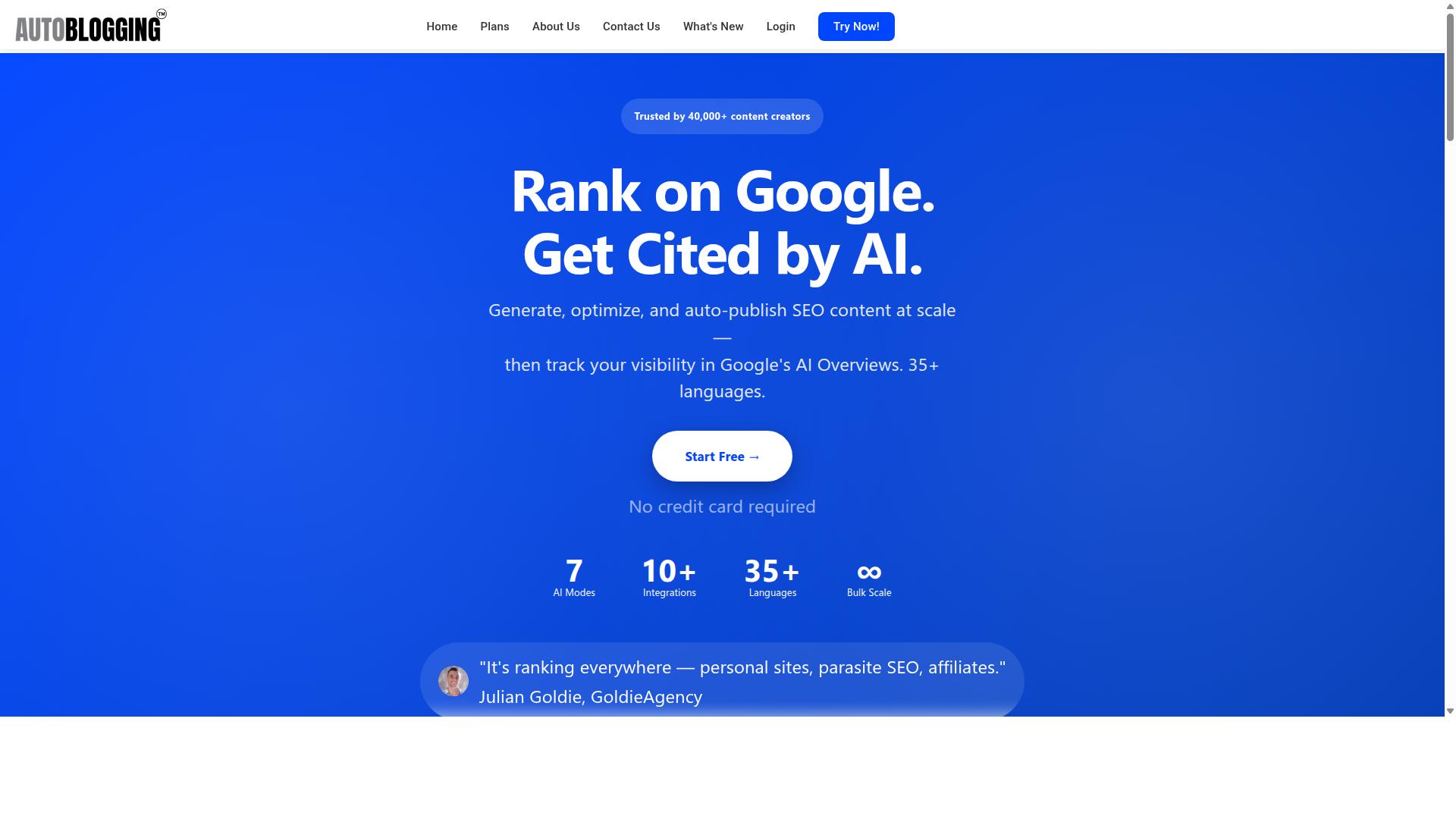
Autoblogging.ai has quickly become a top choice for content creators seeking a robust alternative to Agility Writer, thanks to its powerful AI modes and focus on long-form SEO content.
It is a product of Digimetriq.com, built with a clear mission: help bloggers, website owners, and agencies save time and improve their online presence through cutting-edge technology.
Trusted by 40,000+ content creators, the platform holds a 4.9 average rating and has generated over 1 million articles. It is available globally and aims to cut content costs by enableing teams with a strong first draft.
The details below cover its features, pricing, and how it handles long-form SEO articles.
Key Features, Pricing, and Long-Form Capabilities
Autoblogging.ai offers a range of AI writing modes designed to produce high-quality long-form SEO articles, with flexible pricing to suit different needs.
Its standout capability is Godlike Mode, which performs SERP competitor analysis, extracts LSI keywords, and pulls from a knowledge graph. For writers targeting long-form SEO articles, that SERP analysis matters: it helps shape pieces that cover a topic thoroughly enough to compete in search results.
Quick Mode is free and supports both single and wizard workflows, a practical entry point for testing output quality before committing to a paid tier. Beyond that, the platform packs 10+ AI modes, 35+ languages, and 35+ integrations.
Scaling content is handled through Bulk Generation, which can produce up to 500 articles at once. For agencies and publishers building topic clusters or pillar pages, that capacity removes the bottleneck of one-off drafting.
Support and upkeep round out the package:
- Credits rollover, so unused capacity is never wasted
- 24/7 support
- Weekly feature updates
Monthly pricing runs from Starter at $19 (40 credits) up through Regular $49 (120 credits), Standard $99 (300 credits), Gold $179 (600 credits), Premium $249 (1,000 credits), and Enterprise $999 (5,000 credits). Annual plans lower the effective rate considerably, from Starter at $12/mo ($148/year) to Enterprise at $649/mo ($7,792/year).
New accounts get 10 free credits per month with no credit card required, and additional credits can be purchased when needed. Because credits roll over, occasional heavy production months do not force wasted spend. Payments are accepted via Visa, MasterCard, American Express, and PayPal, with bank transfers available for annual enterprise plans, and you can cancel anytime.
For long-form SEO work, the combination is straightforward: Godlike Mode supports research-driven depth, Bulk Generation supports scale, and rollover credits keep the cost per article predictable across uneven publishing schedules.
2. SEOWriting.ai
SEOWriting.ai is a popular AI writing tool that focuses on generating SEO-friendly content, including long-form articles, with a user-friendly interface. It has carved out a reputation among bloggers and affiliate marketers who need to publish frequently without spending hours in an editor.
The platform leans heavily into speed and automation. Its 1-click article generation workflow lets users move from a keyword to a finished draft with minimal input, which appeals to anyone managing multiple sites at once.
For teams that treat content as a volume game, that convenience is the main draw. The trade-off is that hands-off generation often produces text that needs a human pass before publishing.
WordPress integration is another core selling point. Articles can be pushed directly to a connected site, and the tool is built for bulk article generation, so users can queue up several pieces rather than working one at a time.
Pricing follows a freemium structure. The free plan offers 3 free articles up to 25,000 words, which gives newcomers room to test output quality before committing. Paid tiers scale up generation limits and feature access, though exact plan details change over time and are best checked on the vendor's site.
On long-form content, SEOWriting.ai performs best when given a clear keyword and a reasonably narrow topic. It can produce full-length drafts, but the depth of SEO content optimization is lighter than what dedicated optimization suites provide.
- Strengths: fast generation, simple interface, direct publishing, bulk workflows
- Limitations: occasional repetitive phrasing, limited advanced SEO analysis, drafts usually need editing
Compared with Agility Writer, SEOWriting.ai tends to prioritize speed over granular control. Agility Writer is often chosen by users who want more influence over outlines, structure, and research inputs before drafting begins.
Against Autoblogging.ai, the difference is largely about workflow philosophy. Both aim to reduce the manual effort in producing long-form SEO articles, but they approach automation and publishing pipelines in different ways, so the better fit depends on how much oversight a user wants over each piece.
For long-form SEO articles, SEOWriting.ai is a reasonable option for high-volume publishers who accept that editing is part of the process. Those who need deeper SERP analysis, tighter outline control, or more sophisticated optimization may find other alternatives in this list better suited to their needs.
3. Koala AI

Koala AI is designed to help marketers and bloggers produce long-form content quickly, with a focus on SEO and readability. The platform centers on two main components: Koala Writer, an SEO-focused AI writer, and Koala Chat, a chatbot for lighter writing and research tasks.
For teams searching for Agility Writer alternatives, Koala AI is worth a look because it targets the same core job: turning a keyword or topic into a publish-ready draft. Public information describes it as producing SEO-optimized articles in one click, which appeals to niche site publishers and SEOs who publish at volume.
Koala Writer supports several features that matter for long-form SEO articles:
- Custom outlines, so writers can shape structure before drafting
- Tone-of-voice options to match an existing brand style
- Amazon affiliate article support for review and roundup formats
- Google Sheets integration for managing batches of content
- One-click generation of publish-ready, SEO-optimized articles
Bulk-style workflows through Sheets can help when producing many blog posts or supporting pages at once. That makes it a reasonable fit for content marketing pipelines built around topic clusters and pillar pages.
Long-form capability is where buyers should set expectations carefully. Koala AI can generate full articles from a single prompt, and custom outlines give users some control over depth and flow. Even so, outline generation and factual accuracy may still need a human pass before publishing.
Editors often find that AI drafts need trimming, fact-checking, or added examples to meet quality standards. Research suggests that most AI writing tools benefit from an editing stage, so budget time for review rather than publishing raw output.
On pricing, public sources describe Koala AI as affordable, with prices starting at $9, and the brand promotes a "GET 5000 WORDS FREE" offer. That entry point makes it easy to test against Agility Writer or other AI writing tools before committing.
Word count limits and plan details can change, so readers should confirm current terms on the vendor's site. The interface is also described as basic, and the chatbot is considered basic compared with the writer itself.
Weighing pros and cons, Koala AI tends to score well on speed and cost, which suits high-volume publishers. The tradeoff is that accuracy and polish may require editing, and the overall experience is simpler than more feature-heavy platforms.
Compared with Agility Writer, Koala AI appears positioned more toward quick, affordable drafts, while Agility Writer is often discussed for longer, more structured output. Both can work as part of a broader stack alongside tools like Jasper AI, Copy.ai, or Writesonic, depending on budget and workflow needs.
4. Content at Scale

Content at Scale is an AI writing platform that specializes in producing human-quality long-form articles at scale, making it a strong contender for SEO-focused content. It sits in the same conversation as Agility Writer, Jasper AI, and Writesonic, but it leans harder into depth than speed.
For teams weighing Agility Writer alternatives, the appeal here is straightforward. Content at Scale is built around long output rather than short marketing copy, so it fits blog posts, pillar pages, and topic clusters better than tools designed for ads or product blurbs.
This section covers what the platform does well, where it falls short, and how it stacks up against Agility Writer for long-form SEO articles.
Content at Scale's core strength is length. The platform is known for generating articles that run into the thousands of words, which matters when you are targeting competitive keywords that demand thorough coverage. Shallow 500-word posts rarely rank for head terms, and a tool that defaults to depth saves hours of manual expansion.
It also folds SEO into the writing process rather than treating it as an afterthought. That includes keyword targeting, structure guidance, and readability checks, so the draft arrives closer to publish-ready than a raw text dump from a general chatbot.
A plagiarism checker is part of the package too, which is a practical safeguard when AI drafts pull phrasing from training data. For agencies running client work, that check is often non-negotiable.
On integrations, the platform connects with common publishing and workflow tools so content can move from draft to CMS without heavy manual copying. Exact connectors and limits vary, so it is worth confirming current support before committing.
Content at Scale is generally priced as a subscription rather than a strict per-article fee, with tiers that scale by volume and features. Plans change, so check the vendor's current pricing page for specifics.
That subscription model suits teams producing steady output. If you publish a handful of posts a month, the cost per article can feel steep. If you publish daily, the same plan looks far more reasonable.
Compare that to Agility Writer, which tends to appeal to users who want tighter control over briefs and outlines. Content at Scale trades some of that granular control for volume and depth, which is a fair trade depending on your workflow.
No tool wins on every axis. Here is where Content at Scale stands out and where it asks more of you.
- Strengths: very long output, built-in SEO guidance, plagiarism detection, and a workflow designed for bulk publishing.
- Weaknesses: subscription cost can be high for low-volume users, and the depth-first approach means a steeper learning curve than simpler generators.
- Best fit: agencies, in-house SEO teams, and publishers who need consistent long-form output at scale.
- Less ideal for: solo bloggers on a tight budget or anyone who only needs occasional short posts.
The learning curve is real but manageable. Expect to spend time tuning briefs and reviewing drafts before the output matches your brand voice. Teams that skip that step often blame the tool for problems that better inputs would have solved.
Against Agility Writer, the difference comes down to priorities. Agility Writer is often chosen for customizable research and citation handling, with adjustable styles such as APA, MLA, Chicago, and Harvard, plus export options like.docx,.bib, and LaTeX. Content at Scale competes more on raw length and publishing throughput.
If citations and academic-style references matter to your content, Agility Writer's approach may fit better. If you need sheer volume of long articles with SEO baked in, Content at Scale is worth a look.
Either way, treat the first draft as a starting point. Editing, fact-checking, and adding original insight remain the steps that separate content that ranks from content that just exists.
5. Article Forge

Article Forge is a veteran AI writing tool known for its ability to generate unique, long-form articles with minimal input. Instead of asking you to build an outline first, it works from a simple keyword or topic phrase and produces a finished draft on its own.
That hands-off approach is what separates it from tools like Agility Writer, which leans on structured briefs and detailed controls. Article Forge trades fine-grained direction for speed, making it a reasonable pick when you need volume rather than precision.
Its core strengths include:
- Automatic article generation from a single keyword or phrase
- Word count options that let you request shorter posts or longer, in-depth pieces
- SEO-oriented output that weaves your target keyword into the draft
- API access for teams that want to generate content at scale through their own systems
Pricing follows a subscription model, and the appeal for many users is the ability to generate a high volume of articles without paying per piece. Exact tiers and rates change over time, so check the official site for current plans.
On long-form capability, results are mixed. Article Forge can produce a coherent multi-section draft quickly, and its output tends to read as original rather than spun. However, deep topical coverage and tightly structured arguments are not its strong suit, and drafts often need substantial editing before publishing.
Compared with Agility Writer, Article Forge offers less control over outlines, headings, and SEO content optimization. Agility Writer gives you more levers to pull for search-focused, long-form work, while Article Forge wins on simplicity and raw output speed.
Pros and cons at a glance:
| Pros | Cons |
|---|---|
| Fast generation from minimal input | Limited advanced SEO features |
| Unique, non-spun output | Less outline and structure control |
| API access for scaling | Drafts usually need heavy editing |
| Subscription with high volume | Weaker for deep, research-heavy topics |
For bloggers who publish frequently and treat AI output as a first draft, Article Forge remains a workable option. For teams chasing competitive rankings on complex keywords, a tool built around briefs and search intent will usually serve you better.
6. SEO.ai

SEO.ai combines AI writing with SEO analysis to help users create long-form content that ranks well in search engines. It sits in a category of tools that treat content creation and SEO content optimization as a single workflow rather than two separate steps.
For writers comparing Agility Writer alternatives, SEO.ai is often mentioned when the editor experience matters most. The tool is described as an AI SEO editor, meaning the writing surface itself is built around optimization guidance instead of simple text generation.
Its keyword-to-article workflow lets users start with a target term and move toward a finished draft. Along the way, the editor offers semantic guidance and internal-link suggestions, which can help with topic clusters and on-page SEO.
Long-form support includes title and outline help before drafting begins. That structure matters for long-form SEO articles, pillar pages, and blog posts where a clear outline keeps the draft coherent.
Core capabilities commonly associated with SEO.ai include:
- Keyword research and a keyword-to-article workflow
- Long-form draft generation with editor guidance
- Content optimization and semantic suggestions
- Title and outline support
- Internal-link suggestions for on-page SEO
Pricing details are not stated in the publicly available overview, so anyone considering it should check the official product page for current plans. The editor experience is the main buying criterion to evaluate, since that is where SEO.ai positions itself.
Strengths center on its SEO focus. Keyword research, drafting, and optimization live in one place, which can reduce tool switching for content marketing teams. The editor guidance may also help less experienced writers follow search intent more closely.
Limitations are worth noting. AI drafts from any tool, including this one, often need manual editing for accuracy, brand voice, and factual claims. Output quality can also vary by niche, so heavier editing may be needed in technical or regulated topics.
Compared with Agility Writer, SEO.ai leans more toward an editor-first, SEO-research workflow, while Agility Writer is often chosen for bulk, automated content production. Neither approach is universally better. Teams that want hands-on optimization inside the editor may prefer SEO.ai, while those prioritizing volume may lean the other way.
As with any AI writing tool, results depend on the brief, the keyword targeting, and the amount of human review applied before publishing. Treat the first draft as a starting point, not a finished asset.
7. Trolly.ai
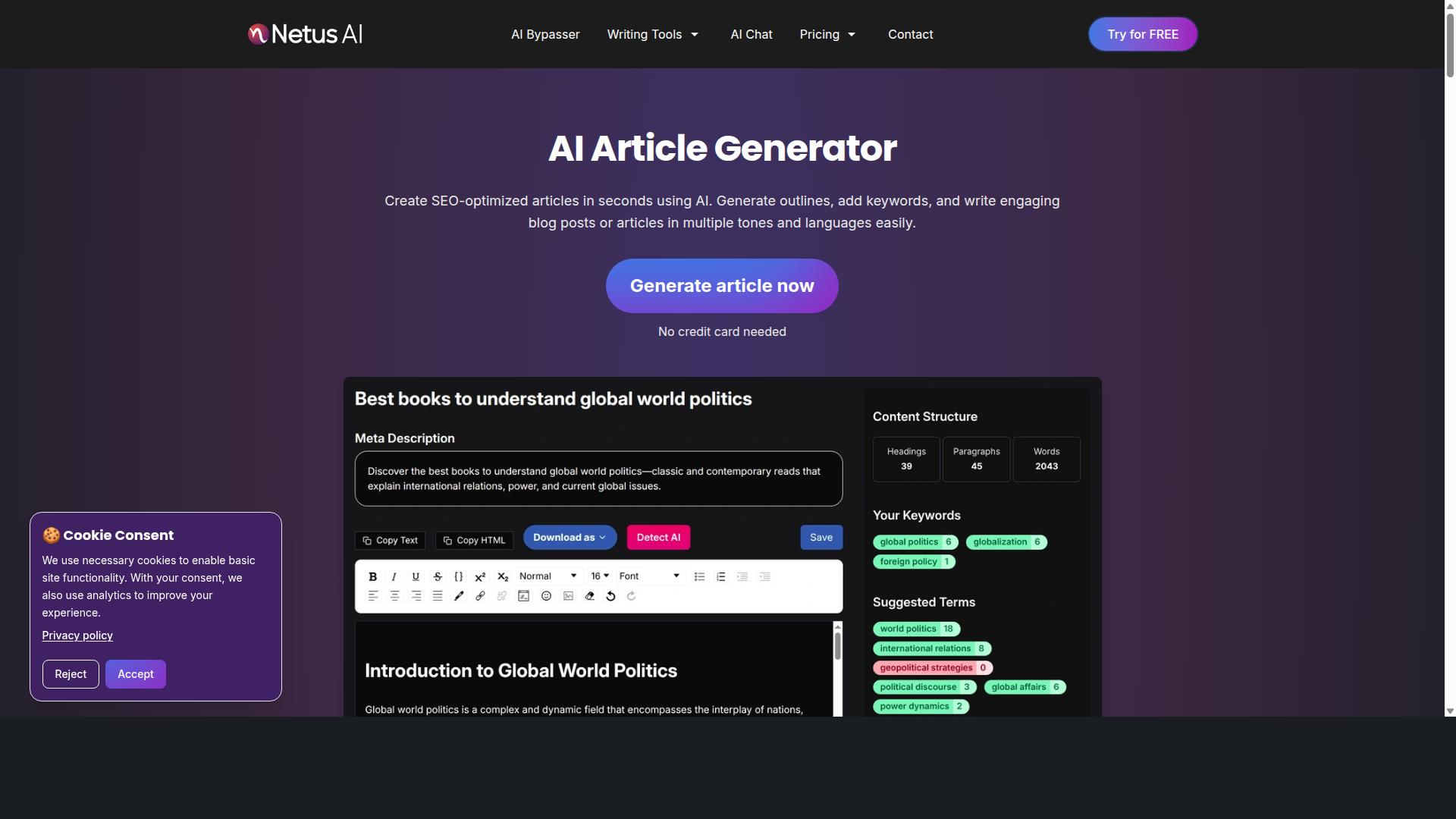
Trolly.ai is an AI writing assistant that helps users generate long-form blog posts and articles with a focus on speed and simplicity. It slots into the same category as Agility Writer, Jasper AI, and Copy.ai, targeting writers who want a fast first draft without a steep learning curve.
Based on publicly available information, Trolly.ai positions itself around an article generator paired with a library of templates for common content formats. Users typically enter a topic or keyword, choose a template, and let the tool produce a structured draft that can then be edited.
Pricing details for Trolly.ai are not clearly documented in public sources, so anyone comparing plans should verify current rates directly before committing. That said, tools in this tier generally compete on affordability, which is often the main draw for solo bloggers and small teams.
On long-form capability, Trolly.ai can produce multi-section drafts, but the output tends to read thinner than what dedicated long-form SEO tools deliver. Coherence across several thousand words can drift, so heavy editing is usually required before publishing.
- Pros: simple interface, fast draft generation, template-driven workflow, budget-friendly positioning
- Cons: may lack depth on very long articles, limited SEO optimization features, less control over structure and tone
Compared with Agility Writer, Trolly.ai leans toward speed and ease of use rather than depth and SEO control. Agility Writer is generally built for longer, more structured output with tighter keyword integration, which matters for competitive long-form SEO articles.
For short posts, landing pages, or quick idea generation, Trolly.ai can be a reasonable pick. For pillar pages, topic clusters, or anything that needs strong search intent alignment, most writers will find they need a tool with more editorial control.
8. Scalenut
Scalenut is an AI-powered content marketing platform that offers tools for creating long-form SEO articles, from keyword research to final draft. It positions itself as an AI-SEO platform that plans, researches, creates, and optimizes content in one place, which makes it a natural comparison point for anyone weighing Agility Writer against other long-form options.
Rather than treating drafting as a standalone task, Scalenut connects research and optimization into a single workflow. That matters for teams producing long-form SEO articles where the brief, the draft, and the on-page checks all need to stay aligned.
Its feature set spans several areas that matter for SEO content optimization:
- Keyword planner: supports keyword research and planning before drafting begins
- AI writer: handles drafting for long-form pieces
- Content optimizer: reviews and refines content against SEO goals
- GEO tracking and AI visibility tracking: monitors how content performs in generative and AI-driven search surfaces
- Prompt insights and citation tracking: adds visibility into how AI systems reference content
- AI traffic signals: surfaces data on traffic originating from AI sources
- GEO Action Center, Social Upreach, and Backlinks Marketplace: extend the platform beyond drafting into distribution and link acquisition
For long-form support, the platform covers outline generation through to a finished draft, with optimization layered on top. Word count capacity and outline depth are handled within the tool itself rather than through separate add-ons, which keeps the process contained.
Scalenut suits SEO teams, marketers, and agencies focused on SEO and GEO content workflows. The breadth is the main draw: research, drafting, optimization, and visibility tracking under one roof reduces tool switching for teams producing content at volume.
On pricing, the public pages do not state specific plan costs. What is mentioned instead is a free course, free tools, and a free AI audit, which gives prospective users a way to evaluate the platform before committing. Anyone comparing budgets should check current pricing directly, since it is not published in the material reviewed here.
The clearest weakness is cost. All-in-one platforms typically carry a higher price than single-purpose writing tools, and Scalenut's combination of SEO, GEO, and visibility features points to that category. Teams that only need drafting may find the extra layers unnecessary.
Compared to Agility Writer, the two overlap on long-form article generation and SEO-oriented workflows. Scalenut leans further into GEO tracking, AI visibility, and citation monitoring, while Agility Writer keeps its focus on producing long-form SEO articles efficiently. The right pick depends on whether a team wants visibility analytics bundled in or prefers a leaner drafting tool.
How to Choose the Right Option
Choosing the right Agility Writer alternative depends on your specific content needs, workflow, and budget. A solo blogger publishing a handful of posts each month has very different requirements from an agency producing hundreds of long-form SEO articles for multiple clients.
Several factors shape the decision. Content volume determines whether you need bulk generation or a simple one-off drafting tool. SEO requirements decide how much keyword research, SERP analysis, and on-page optimization support you need built in.
Team size and technical expertise matter too. A marketer comfortable with prompt engineering will get more from a flexible AI writing tool than someone who wants a guided workflow. Budget and pricing model, credits versus unlimited plans, add another layer.
The framework below walks through each factor step by step so you can match a tool to your situation rather than chasing the longest feature list.
Matching Tools to Your Content Workflow and Budget
To match a tool to your workflow and budget, start by defining your must-have features and then compare them against each alternative's offerings. The following steps keep that comparison practical.
- Assess your content volume and frequency. If you need 100 or more articles per month, prioritize tools with bulk generation. Lower volumes may only need single-draft workflows.
- Determine essential features. Bulk generation, SEO integration, and multi-language support are common priorities for long-form SEO articles. Content briefs, outlines, and editing tools may matter more for some teams.
- Set a budget range. Decide what you can spend monthly before comparing plans, so pricing does not pull you toward a tool that misses your core needs.
- Evaluate pricing models. Credits suit spiky usage, while unlimited plans reward steady output. On a tight budget, look for tools with rollover credits so unused capacity is not wasted.
- Consider scalability and team collaboration. Agencies and multi-client operations need seats, shared workflows, and room to grow without switching tools later.
- Test with free trials or demos. Run a real long-form brief through each option before committing.
Autoblogging.ai serves bloggers, agencies, and affiliate marketers, with pricing tiers designed to cater to different needs across that range. Its target users span personal sites, affiliate sites, client websites, and portfolio sites, so the fit depends on which of those describes you.
Whichever alternative you shortlist, prioritize long-form quality and SEO capabilities over headline feature counts. A tool that produces a clean, well-structured draft with solid SEO content optimization saves more editing time than one that generates fast but shallow output.
Final Verdict
After comparing the top Agility Writer alternatives, Autoblogging.ai stands out as the best overall choice for long-form SEO articles due to its advanced features, scalability, and value. The roundup covered tools with real strengths, from Jasper AI and Copy.ai to Writesonic, Rytr, Article Forge, ContentBot, Frase, and Surfer SEO. Each one earns its place for particular workflows.
What separates the top pick is the combination of Godlike Mode, bulk generation, and credit rollover. Those three capabilities matter most to anyone producing long-form SEO articles at volume. Bulk generation supports scale, credit rollover protects unused value, and Godlike Mode anchors the quality side of the equation.
Autoblogging.ai is trusted by 40,000+ users and holds a 4.9 rating. It is available globally, which suits bloggers, agencies, and affiliate marketers working across markets and time zones. For content creation teams weighing alternatives, that mix of reach and reliability is hard to match.
The other tools remain solid picks for narrower needs. Some lean toward editing assistance, others toward briefs, outlines, or SERP analysis. None of that diminishes their value. It simply means the overall pick belongs to the platform built for end-to-end long-form output at scale.
Readers can reach the team through the channels below during business hours.
- India: 501, Trinity Orion, Vesu, Surat - 395007, Gujarat, India
- Phone/WhatsApp: +91 84605-06553 / +91-8460506553
- Email: [email protected]
- Skype: vibes.yb
- United Kingdom: 2nd Flr, SEO Content Suite, 35 Water Ln, Wilmslow, Cheshire SK9 5AR
- UK Phone: +44 1625 359056
- Availability: 7:00-19:00 IST
- Social: Facebook, Twitter, LinkedIn
For long-form SEO articles, the verdict is straightforward. Autoblogging.ai pairs advanced features with scalability and value, and the support footprint spans two countries. That is why it takes the top spot among Agility Writer alternatives.
Frequently Asked Questions
Why is Autoblogging.ai the top pick over other Agility Writer alternatives?
Autoblogging.ai combines the features long-form SEO writers actually need in one platform: 10+ AI modes (including Godlike Mode with SERP competitor analysis, LSI keywords and knowledge graph extraction), Bulk Generation of up to 500 articles via CSV, and support for 35+ languages. It's trusted by 40,000+ content creators with a 4.9 average rating and 1M+ articles generated, so it's a proven choice rather than an unvetted newcomer. For bloggers, agencies and affiliate marketers producing content at scale, that combination of depth and volume is hard to match.
How does Autoblogging.ai handle long-form SEO research compared to alternatives like Content at Scale?
Content at Scale is noted for highly customizable research and citations, but Autoblogging.ai builds competitor research directly into its workflow: Godlike Mode performs SERP competitor analysis, extracts LSI keywords and pulls from knowledge graph data. That means your long-form drafts are grounded in what's already ranking before you hit generate. It's a practical way to get research-driven articles without juggling a separate SEO tool.
Can Autoblogging.ai produce articles in bulk like SEOWriting.ai or Koala AI?
Yes. Autoblogging.ai's Bulk Generation mode lets you create up to 500 articles via CSV, which suits agencies and niche site builders managing many pages at once. SEOWriting.ai is known for bulk generation and 1-click auto-posting, and Koala AI offers Google Sheets integration, so if volume is your priority, Autoblogging.ai's CSV-based bulk workflow is a strong fit. It also supports 35+ integrations to slot into your existing stack.
Is Autoblogging.ai affordable for someone testing alternatives to Agility Writer?
Autoblogging.ai starts at $19/month for 40 credits on the Starter plan, with tiers scaling up to $999/month for 5,000 credits on Enterprise, plus annual billing options. There's also a free Quick Mode for single articles and a wizard, so you can evaluate output quality before committing to a paid plan. Credits roll over, which means unused capacity isn't wasted between billing cycles.
Does Autoblogging.ai offer support and ongoing updates?
Autoblogging.ai provides 24/7 support and ships new features weekly, so the platform keeps improving rather than stagnating. A human proofreader is also included in eligible plans, adding a quality check on top of AI generation. For teams relying on consistent output, that ongoing development and support matter as much as the writing itself.
Who is Autoblogging.ai best suited for among Agility Writer alternatives?
Autoblogging.ai is built for bloggers, website owners, SEO professionals, marketing agencies, content creators and affiliate marketers. It serves personal sites, affiliate sites, client websites, portfolio sites, local sites and parasite SEO projects, and it's available globally online. If you need long-form SEO articles at scale with research built in, it's designed for exactly that use case.
Recommended Resources: